

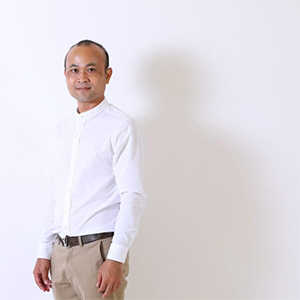
Suriya Namwong
Suriya Namwong
b. 1978, resides and works in Bangkok, Thailand
Suriya Namwong was born in Roi Et Province, Thailand. He received his Bachelor of Fine Arts in Painting from Srinakharinwirot University in 2001, graduating with second class honors, and his Master of Fine Arts in Visual Arts, specializing in Thai Art, from Silpakorn University in 2012. He is currently pursuing a Doctor of Philosophy in Visual Arts at the Faculty of Painting, Sculpture, and Graphic Arts, Silpakorn University. His academic formation reflects an ongoing negotiation between traditional Thai artistic knowledge and contemporary modes of inquiry, grounded in a sustained interest in time, impermanence, and the cyclical conditions of existence that shape processes of death and regeneration.
Namwong’s work has been presented consistently across institutional and contemporary exhibition contexts, with site-specific installation emerging as a central mode of practice in recent years. His recent projects in 2025 include “What Exists as Shadow” and “Hope from the Relationship of Death and Rebirth” at Phimai Historical Park, alongside his participation in the 3rd Art for Refugees exhibition at MOCA BANGKOK. In 2024, he presented “The Death of the Yang Na Tree and the Relationship of Birth” at the Silpakorn University Art Center. Earlier solo exhibitions such as “Transformation Mind” at the National Gallery, Thailand in 2015 and “Abstract from Thai Architectural Ornament” at ARDEL Third Place Gallery, Bangkok in 2013 mark a gradual shift in his practice from an engagement with visual form toward the construction of spatial and perceptual experience.
Namwong’s practice is grounded in an understanding of space as a generative condition of meaning. His works often begin with a close reading of site, where historical context, ecological conditions, and systems of belief are approached as active agents rather than background. These elements are translated into spatial configurations that allow meaning to unfold over time, rather than being fixed at the level of image. The use of natural materials operates not only as a formal choice but as a conceptual register through which relationships between human and nonhuman systems are articulated, reflecting cycles of emergence, transformation, and dissolution informed by Eastern philosophical thought.
Alongside his artistic practice, Namwong serves as a curator at MOCA BANGKOK, where he contributes to the development of exhibitions that engage contemporary art within broader social and cultural frameworks. His dual role situates him between the production and mediation of art, extending his practice beyond individual works toward the shaping of contexts in which meaning is continuously negotiated within contemporary society.
Project artist
No posts found.
