


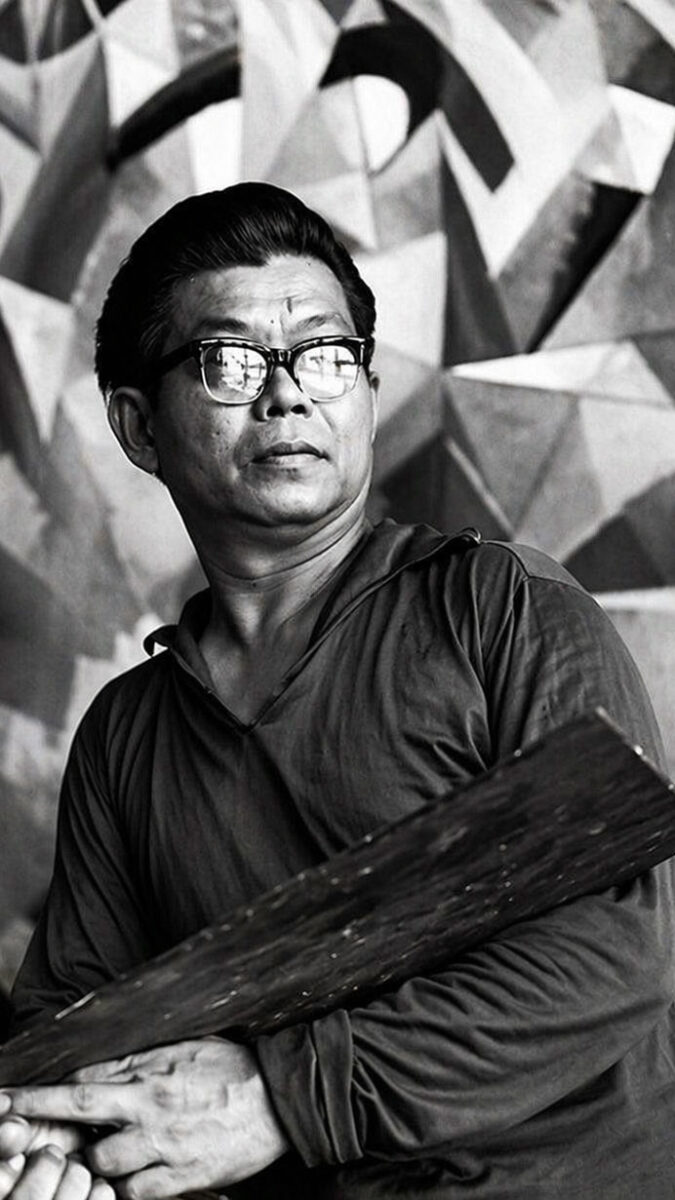
Truth of Art Beyond Boundaries
Fua Haripitak, National Artist, and the Truth of Art Beyond Boundaries
The Artist Who Refused to Conform
Believe it or not, Fua Haripitak, later regarded as the “master teacher of Thai art,” once failed a drawing class. The reason was simple. It was not that he lacked skill. On the contrary, he was among the most talented students of his generation. What set him apart was a decision: he chose not to draw in the way the curriculum prescribed. His life, in many ways, became a quiet but persistent affirmation that truth in art never resides within boundaries drawn by others.
The Beginning of a Way of Thinking
Fua Haripitak was born in 1910 in Thonburi. (an area of modern Bangkok, Thailand) He enrolled at Poh-Chang Academy of Arts and demonstrated remarkable ability from an early stage. He passed nearly every subject, standing at the threshold of graduation. Yet in the final assignment, where he was required to produce a conventional study, he instead created an abstract work guided by his own sensibility. The result was failure, and he chose to leave the institution just steps before completion. This moment was not simply an act of defiance but the beginning of a lifelong position: that art cannot arrive at truth if it remains confined within inherited frameworks.
When Art Is No Longer Defined by Conditions
His life soon entered a period of profound upheaval. During World War II, he was taken as a prisoner of war and held in an internment camp in India. Under conditions that stripped away stability, comfort, and freedom, he continued to draw. Within the camp, he was awarded both first and second prizes in an art competition. Hardship did not interrupt his creative impulse. Instead, it revealed that art could persist even in environments where almost nothing else remained.
Hardship as Material
It was during this time that he created Japanese Internment Camp, Purana Qila, a work later recognized by the National Museum of Modern Art Tokyo as one of the earliest examples of Cubism in Asia.
Recognition and Artistic Formation
After the war, Haripitak continued to develop his practice and gained national recognition. He received three gold medals from the National Exhibition of Art for Phetchaburi in 1949; Prakaiphet, or Madame Chit Rianpracha, in 1950; and Woman in a Red Round-Neck Shirt, widely known as Suea Daeng or Italian Girl, in 1957. These achievements led to his recognition as a master artist in painting and gradually affirmed his place within the history of Thai art. In 1985, he was officially named a National Artist in visual arts.
Conviction Beyond Credentials
Amid this trajectory, in 1954, he traveled to study at the Academy of Fine Arts in Rome. He carried no formal academic credentials with him. What he had was a single letter of recommendation from Prof. Silpa Bhirasri, which simply stated that “…, Nai Fua Haripitak may be recommended as one of the best Siamese artists of our time.” That statement alone was enough to open the door.
Preservation as an Act of Understanding
Yet the most significant part of his life does not lie in recognition or achievement but in what he chose to do upon returning to Thailand. He moved into the Tripitaka Library at Wat Rakhang Kositaram to restore ancient mural paintings. He lived there for over a decade, to the extent that locals came to call him “the ghost of the scripture hall.” His method was defined by restraint and reverence.
Letting the Original Emerge
He did not repaint, retouch, or alter what was there. Instead, he carefully removed layers of dust and residue, allowing the original work to gradually re-emerge. For Haripitak, repainting was not preservation. It was an erasure of what already existed.
Tracing as a Way of Knowing
At the same time, he traveled across the country to trace temple murals onto translucent paper. This was not an act of replication in a superficial sense but an attempt to understand the underlying structure, rhythm of line, and spirit of traditional craftsmen. At a time when Thai art education had yet to be systematically developed, his work became foundational to the formation of knowledge in Thai art.
Art, Truth, and Stepping Beyond the Frame
Fua Haripitak did not leave behind only artworks. He left a way of thinking. His life demonstrates that art is bound to truth, to sincerity, and to a deep respect for what stands before us. A man who once failed a drawing class became, in time, the master teacher of Thai art. And perhaps, stepping beyond the frame from the very beginning was never a misstep, but the very condition that allowed him to see more clearly than others.
References:
กฤษณา หงษ์อุเทน. (2568). 22 เมษายน วันคล้ายวันเกิด เฟื้อ หริพิทักษ์ ศิลปินแห่งชาติ. ศิลปวัฒนธรรม.
เกษศิรินทร์ ผลธรรมปาลิต. (2566). หอจดหมายเหตุ เฟื้อ หริพิทักษ์ เรื่องเบื้องหลังที่ไม่เคยเล่าของครูใหญ่แห่งวงการศิลปะ. Sarakadee Lite.
ตัวแน่น. (2566). ‘เฟื้อ หริพิทักษ์’ ครูใหญ่ศิลปะไทยที่ชีวิตโลดโผน ศิลปินไส้แห้งอินเลิฟหญิงสูงศักดิ์. The People.
มหาวิทยาลัยศิลปากร. ๑๐๐ ปี เฟื้อ หริพิทักษ์ : ชีวิตและผลงาน (A Century of Fua Hariphitak : Life and Works). (E-book).
รัฐพงศ์ เกตุรวม. เฟื้อ หริพิทักษ์ : ครูใหญ่แห่งวงการศิลปะ. สำนักพิพิธภัณฑสถานแห่งชาติ กรมศิลปากร.
สำนักงานราชบัณฑิตยสภา. ศาสตราจารย์ เฟื้อ หริพิทักษ์. ฐานข้อมูลภาคีสมาชิก.
สุรัตน์ โหราชัยกุล และ ณัฐ วัชรคิรินทร์. (2566). รำลึกบรมศิลปาจารย์ เฟื้อ หริพิทักษ์. สถานีวิทยุจุฬาฯ (Chula Radio Plus).
Rama IX Art Museum. เฟื้อ หริพิทักษ์ | ชีวิตและผลงานคัดลอกจิตรกรรมไทยประเพณี.
Thai PBS. (2563). ความจริงไม่ตาย: ชีวิตศิลปิน “เฟื้อ หริพิทักษ์”. (วิดีโอ YouTube).
The Art Auction Center. (2023). ชีวิตที่ครบรสดั่งบทละครของ เฟื้อ หริพิทักษ์.
Wikipedia. (2024). Fua Haripitak.
ภาพจาก อวบ สาณะเสน 72 ปี: นิทรรศการผลงานศิลปกรรม (2550), ณ หอศิลป์สมเด็จพระนางเจ้าสิริกิติ์ พระบรมราชินีนาถ.
More stories
Open Call for Art Competition
View more30/07/2568
