

THAILAND
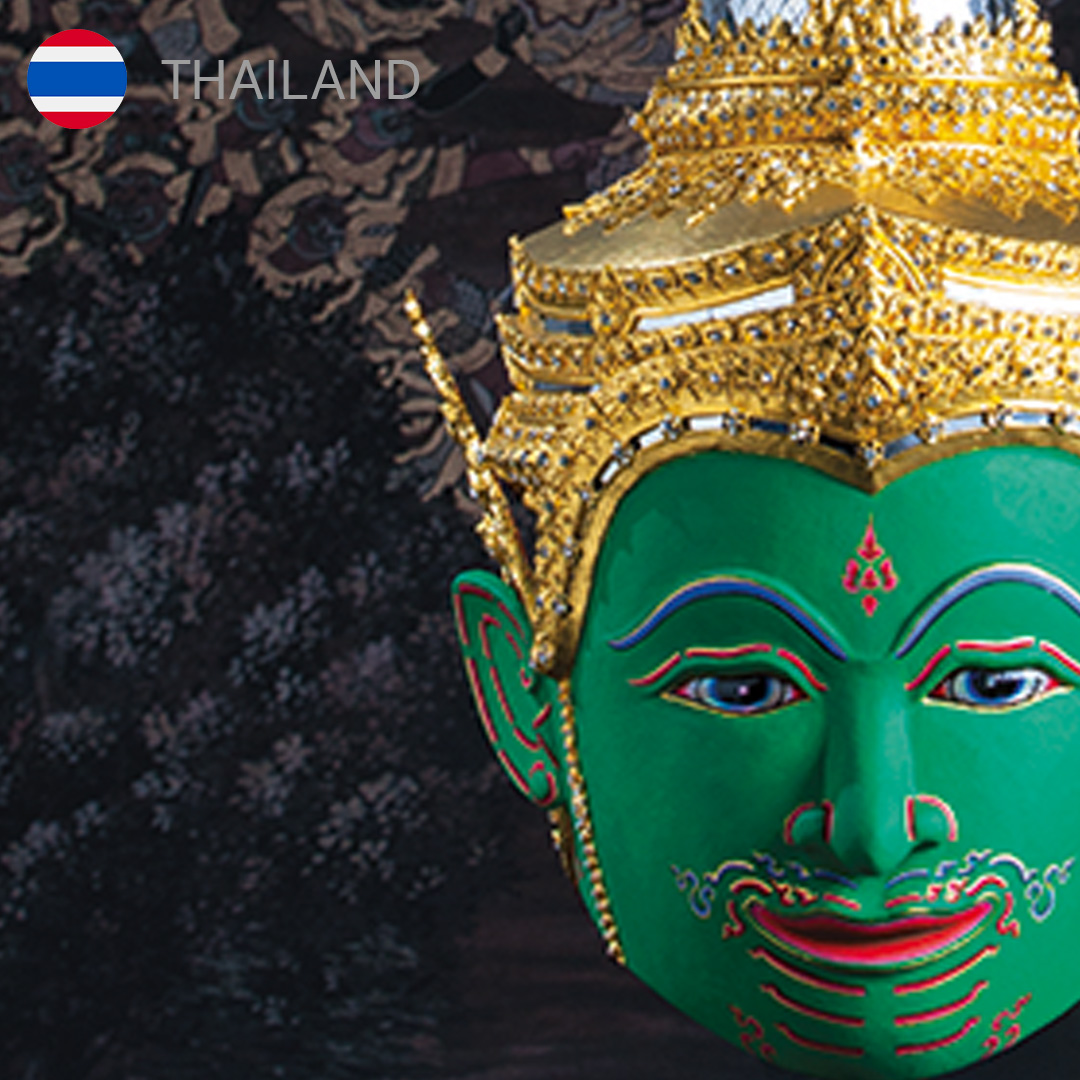
The sacred epics of the Brahmanic and Hindu tradition, which shaped the faith, moral order, and worldview of its followers, have continued to live on in Thailand to this day. Both the Mahābhārata and the Rāmāyaṇa remain deeply rooted in Thai literature, mural painting, and the performing arts. In particular, the Rāmāyaṇa, known in Thailand as Ramakien, has become one of the most significant cultural foundations of the Thai imagination.
Although no definite archaeological evidence has been found to determine when the Rāmāyaṇa first reached the Thai region, scholars believe that Khon, the masked dance drama, may have developed from the ancient ritual of Chak Nak Duek Dam Ban, or the “Tug of Naga Ceremony.” This ritual appears in the Palace Law on the Indrabhisek Royal Ceremony and derives from the myth of the Churning of the Ocean of Milk, which originates from the Kurma Avatar, one of the ten incarnations of Vishnu in Vaishnavism. The word Duek Dam Ban is thought to have come from the Khmer term tuek tuban, meaning “to churn water,” which can still be seen in the bas-reliefs on the eastern gallery of Angkor Wat in Cambodia.
Ancient city-states such as Ayutthaya, Lavo, Suphannaphum, and Sukhothai maintained close relations with the Khmer Empire. Through these connections, the spiritual and artistic influences of Indian civilization, transmitted via Khmer culture, spread widely across the region that would later become Thailand.
The names of Rāma, Lakṣmaṇa, and the demon king Tosakanth (Rāvaṇa) appear in the ancient Thai literary text Lilit Ongkan Chaeng Nam (The Water Oath Lilit), which historian Jit Phumisak noted was composed during the reign of King U Thong, the founder of Ayutthaya, around 1350 CE (B.E. 1893). This text was recited during the royal oath of allegiance ceremony, affirming the loyalty of royal officers and courtiers.
Historical evidence shows that Khon performances were already established at the royal court during the reign of King Ramathibodi II, around 1457 to 1529 CE (B.E. 2000 to 2072), as mentioned in Lilit Phra Lor: “The stage of Khon and dance was prepared, and candles were lit for the grand performance.” This reference indicates that Khon was performed as part of royal funerary rites.
Shadow puppet theater, Nang Yai and Nang Talung, also flourished during the Ayutthaya period in the fifteenth century CE (B.E. 2000s). The historian James R. Brandon of Harvard University wrote in Theatre in Southeast Asia that these shadow plays often drew from the Rāmāyaṇa. Some researchers further suggest that the use of painted facial makeup, originally inspired by Indian traditions, evolved into the distinctive Khon masks during the reign of King Borommakot, around 1732 to 1758 CE (B.E. 2275 to 2301).
French envoy Simon de La Loubère, who visited Siam during the reign of King Narai (1656 to 1688 CE / B.E. 2199 to 2231), described Khon in detail: “The Siamese have three kinds of theater. The type called Khon consists of stylized dance movements accompanied by music. The performers wear masks and carry weapons, enacting scenes that emphasize combat more than dance. The masks are mostly grotesque, representing animals or demons with fierce appearances.”
Later, Captain James Low, an English scholar of Southeast Asian culture, observed during the Rattanakosin period (18th to 19th century CE / B.E. 2300 to 2400s) that “the Siamese have refined their dramatic art to a high level of perfection and have even spread it to neighboring countries such as Burma, Laos, and Cambodia, which all seek to employ Siamese dancers.”
The grandeur of the Rāmāyaṇa that spread across Suvarnabhumi, or Southeast Asia, can still be seen in Thai tradition, custom, and art. The legacy of this epic remains embedded in royal symbolism, such as the title “Ramathibodi” used by the kings of Ayutthaya, the designation “King Rama” in the Rattanakosin era, and the emblem of Garuda as the national insignia representing Vishnu’s divine vehicle in Brahmanic belief.
The influence of the Rāmāyaṇa on Thai culture is profound, permeating mural painting, literature, performing arts, and the decorative crafts. Khon, as a royal performance, has long been associated with state ceremonies since the Ayutthaya period, symbolizing the majesty of kingship. It stands as a royal art form that has endured and evolved through centuries.
The sustained support and patronage of Thai monarchs have been essential to its survival. King Taksin of Thonburi (r. 1767 to 1782 CE / B.E. 2310 to 2325) composed episodes of Ramakien for royal performance. King Rama I, or Phra Phutthayotfa Chulalok (r. 1782 to 1809 CE / B.E. 2325 to 2352), wrote a complete version of the Ramakien. King Rama II, or Phra Phutthaloetla Naphalai (r. 1809 to 1824 CE / B.E. 2352 to 2367), composed four episodes, while King Rama IV, or King Mongkut (r. 1851 to 1868 CE / B.E. 2394 to 2411), wrote Phra Ram Journeying in the Forest to Keep His Father’s Oath. Later, King Chulalongkorn (Rama V) (r. 1868 to 1910 CE / B.E. 2411 to 2453) and King Vajiravudh (Rama VI) (r. 1910 to 1925 CE / B.E. 2453 to 2468) also wrote their own versions of the Ramakien.
Her Majesty Queen Sirikit The Queen Mother, Queen Consort of King Bhumibol Adulyadej (Rama IX) (r. 1946 to 2016 CE / B.E. 2489 to 2559), took Khon under her royal patronage. Lavish productions of Ramakien were staged with national acclaim and international recognition. This royal encouragement revitalized Khon, inspiring new generations of artists and mask makers, and affirming its status as one of the most exquisite performing arts in Southeast Asia.
The journey of the Rāmāyaṇa into Thailand connects deeply with the broader question of Thai origins, an inquiry that continues to evolve as new archaeological discoveries emerge. Excavations at the ancient city of U Thong reveal settlements more than three thousand years old. During the eleventh to sixteenth Buddhist centuries (approximately 6th to 11th century CE / B.E. 1043 to 1643), this area, along with Nakhon Pathom and Lopburi, formed the heart of the Dvaravati Kingdom. Archaeologists have unearthed Buddha images in the Amaravati style dating to the fourth century CE (B.E. 900), demonstrating the long continuity of cultural exchange.
Although no evidence older than the sixteenth Buddhist century confirms the existence of Khon in early Thailand, the art of Khon has developed continuously, expanding in creativity beyond its Indian origins. Today, young Thai artists continue to embrace this heritage, reinterpreting the Ramakien through contemporary Khon dance, a modern form that bridges tradition and innovation, and proudly bringing Thai culture to the international stage.
