

MYANMAR
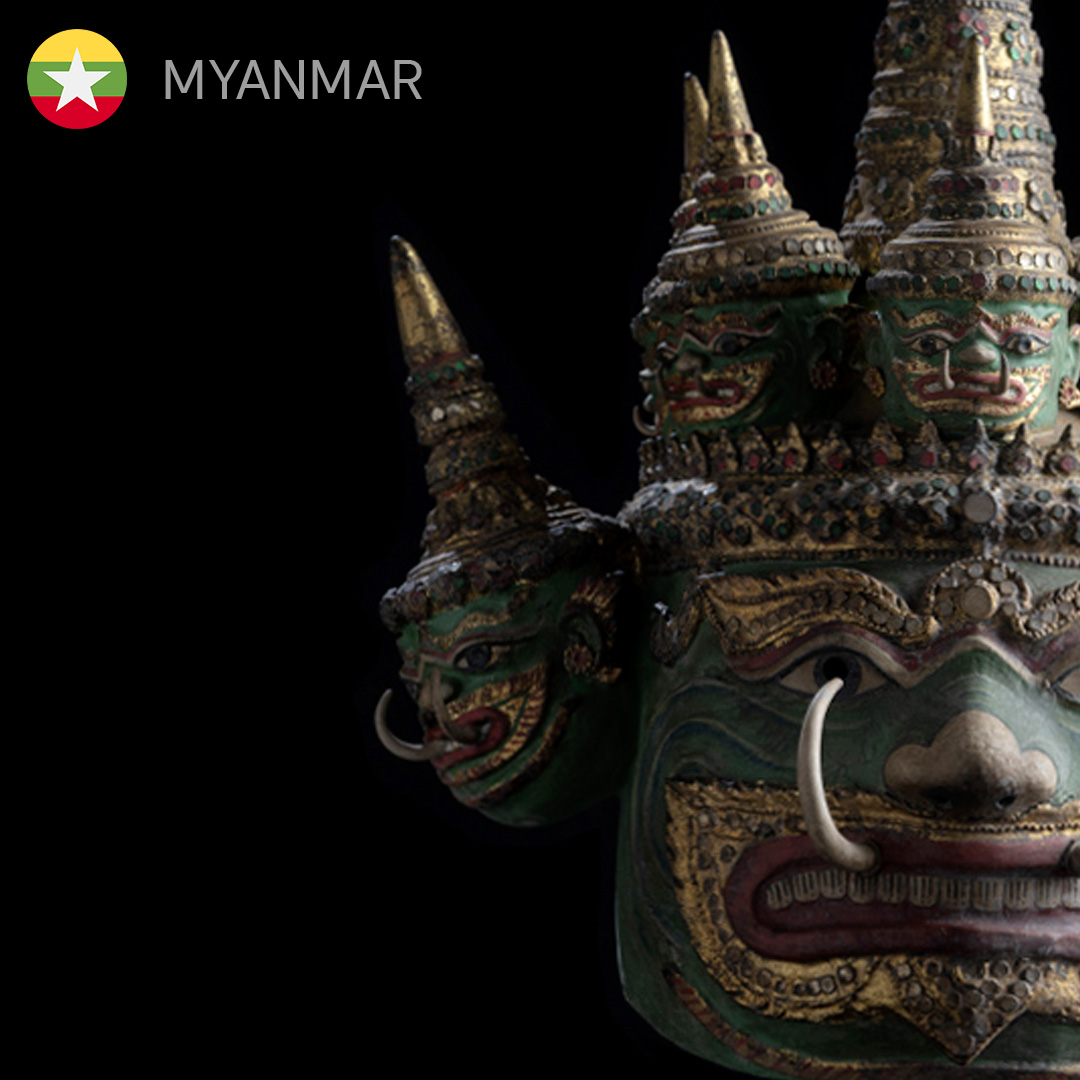
Myanmar is home to numerous ethnic groups, including the Mon, Burmese, Chinese, Shan, Tai Yai, Tai Noi, and many other hill tribes. Throughout its history, the country has experienced wars and conquests both within and beyond its borders. It was once a tributary state of China and the Mongol Empire, and during the colonial period, it came under the rule of the United Kingdom.
Myanmar’s culture developed from a blend of native traditions and influences from neighboring countries. Among its cultural legacies, the use of masks remains partly connected to beliefs in gods and spirits, particularly among remote ethnic communities. Although Indian civilization had a strong influence on Myanmar, the tradition of mask-making is found mainly in performances of the Rāmāyaṇa, which is believed to have originated from the Ayutthaya Kingdom.
The Burmese version of the Rāmāyaṇa is called Yama Zatdaw, meaning “The Ramayana Jataka.” The earliest known performance took place around 1527 CE (B.E. 2070) at Nyaung U Temple in Bagan. Within the city stood a temple dedicated to Vishnu that contained a stone sculpture of Rāma, known as Ramachandra. However, there is no evidence that theatrical masks were created during that period.
Thai historians have noted that after the fall of Ayutthaya in 1767 CE (B.E. 2310), Burmese forces returned with many captives, including aristocrats, artisans, musicians, and performers. As a result, the Burmese Rāmāyaṇa absorbed significant influence from the Thai Ramakien.
During the reign of King Singu Min (B.E. 2319–2324 or 1776–1781 CE), the royal court actively promoted the performing arts. The queen, a renowned poet, encouraged the adaptation of the Rāmāyaṇa in Burma. New songs were composed, costumes redesigned, and masks created in a distinctly Burmese artistic style.
When Theravāda Buddhism became the dominant religion, royal patronage of the performing arts gradually declined. Court performances came to be viewed more as entertainment than as moral instruction, and state support waned. Nevertheless, the tradition survived in rural communities, where performances continued as popular entertainment.
The Saing Waing ensemble, Myanmar’s national orchestra, often accompanied Rāmāyaṇa performances. Its central instrument is the Pat Waing, a circular drum set that defines the ensemble’s distinctive sound. The Saing Waing is sometimes called Pat Saing, while the drum set itself is referred to as Pat Waing. The ensemble is performed at both formal and informal occasions, including ordination ceremonies, ear-piercing rituals, spirit ceremonies, graduations, and state receptions.
The music of the Saing Waing possesses a unique expressive range that can convey joy, excitement, and sorrow. It is regarded as one of the most flexible and emotionally rich forms of music in Myanmar’s heritage. Although masked performance in Myanmar has not evolved as extensively as in some neighboring countries, it remains a vital aspect of the nation’s cultural identity.
Khon-style masks from Myanmar have been found in Bagan and Mandalay, providing tangible evidence of the Rāmāyaṇa’s influence and how Burmese artists reinterpreted it through their own cultural aesthetics.
