


INDONESIAN
Retracing the origins of the Rāmāyaṇa epic leads us back to the ancient maritime routes mapped in early navigation charts. These records show the passage of Indian merchant fleets sailing along the Indochinese peninsula from Chaiya down to its southernmost tip, extending onward to the major archipelagos of Sumatra, Borneo, Bali, Java, and as far as New Guinea. This vast region, comprising more than ninety-eight trading settlements, formed an interconnected network shaped by maritime exchange.
Chinese chronicles of the Liang Dynasty (502–556 C.E.) describe the polity of Langkasuka as having already flourished for over four centuries. This region consisted of multiple independent city-states, including the kingdom of Tambralinga on the eastern Malay Peninsula between Chaiya and Pattani, centered at Nakhon Si Thammarat. A sixth-century Sanskrit inscription discovered in this area further attests to its Indian connections. Georges Coedès’s influential theory posits that Palembang functioned as the capital of Srivijaya, a maritime empire that controlled trade through the Straits of Malacca and Sunda. Merchant vessels traveling from the western world to the East were compelled to pass through these waterways, enabling Srivijaya to prosper from the sixth to the fourteenth century C.E.
For nearly a millennium, the Indonesian archipelago absorbed literary, ritual, and artistic traditions from India, particularly those associated with Hinduism and Buddhism. Their influence remains visible today. The Balinese language preserves Sanskrit as a principal liturgical foundation, and enduring devotion to the sage Mārkaṇḍeya (Markandeya), believed to have guided early Indian settlers to Bali, continues to shape spiritual practice. Many Balinese personal names still derive from Sanskrit roots.
Maritime routes linking India to Suvarnabhumi also brought Indian settlers to Sumatra across centuries. Many arrived for trade, new opportunities, or the propagation of Hindu teachings, bringing with them artistic traditions, ritual practices, and cultural frameworks. Sumatra and Borneo later became part of the Srivijaya Empire and the Śailendra Dynasty, both maintaining close ties with the Pāla Dynasty of India. Historical evidence documents royal patronage for Nālandā University from around 860 C.E., and Chinese monks often resided in Sumatra for months while awaiting favorable winds to continue their journey to India.
On Sumatra and Borneo, local adaptations of the Rāmāyaṇa came to be known as Hikayat Seri Rama. The narrative diverged meaningfully from the Indian original, describing, for example, Hanumān as the son of Rāma and altering names such as Sri Ram to Seri Rama and Sita Devi to Sita Detti. Malay scholars note that Hikayat Seri Rama, alongside the Tamil Rāmāyaṇa, forms the foundation of the early Malay Rāmāyaṇa tradition, later enriched by celebrated authors such as Kikayat Marang Mahavamsha. Performances on these islands commonly took the form of puppetry and shadow theater. In Borneo and Kalimantan, where Hindu communities were prominent, performers adopted classical Indian idioms such as Bharatanāṭyam in movement, costume, and mask-making. Masks used include Rāvaṇa (Rawana), Gaṇeśa (Ganesha), and ritual Dayak masks such as Indai Gura, associated with healing and the expulsion of malevolent forces.
The most renowned Rāmāyaṇa performances in Indonesia are found on Java and Bali, where the epic is known as Kakawin, the classical Javanese rendition. These performances appear as contemporary dance dramas or Wayang Wong shadow theater, particularly at the Prambanan temple complex and in Yogyakarta. On Java, related traditions include Sendratari performances in Ubud and the iconic Kecak performances at Uluwatu. Characters retain Sanskrit names while adopting Indonesian pronunciation, as seen in Rāvaṇa (Rawana), Gaṇeśa (Ganesha), and Hanumān (Hanuman).
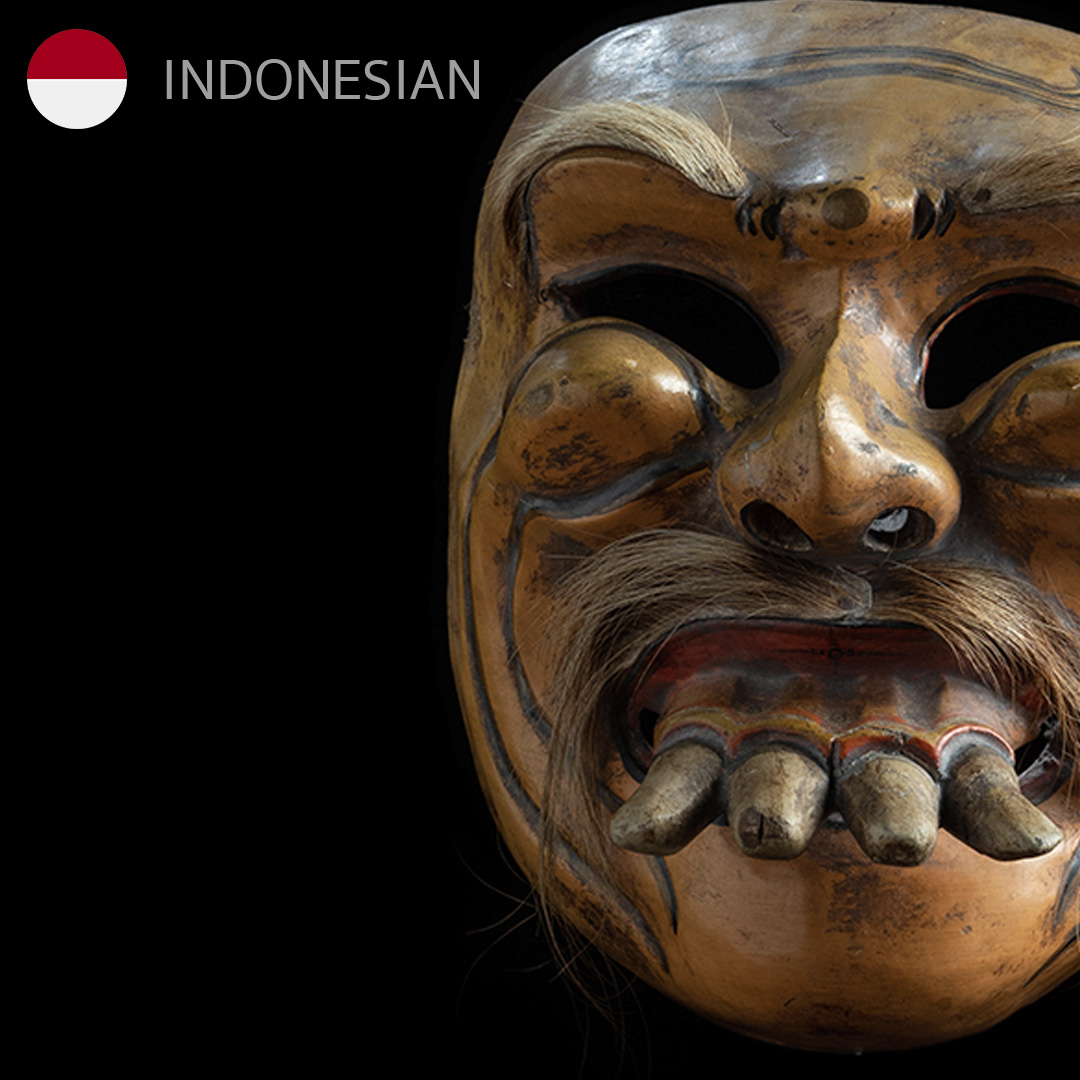
Beyond Kakawin, Indonesia’s indigenous mask traditions form an essential component of its cultural landscape. Bali is home to the towering Barong Landung masks, including Barong Singha and Barong Macan, while Wayang Topeng masks represent the Panji cycle, particularly Topeng Keras and Topeng Tua, used in ritual contexts and heroic storytelling. Topeng, one of Indonesia’s earliest artistic forms, dates to the fifteenth century. Originally produced within royal courts, masks served to conceal the identities of kings and nobles during wartime. Over time, this tradition passed into the hands of commoners, who preserved it through ritual and performance.
Mask cultures across the Indonesian archipelago display extraordinary diversity, ranging from Kalimantan, Lombok, Madhura, and Batak regions to the profound ancestral traditions of the eastern islands. Notable examples include the Ancestor Mask of the Asmat people and the Tetum Mask from Timor-Leste, both embodying deeply rooted systems of ancestral guardianship and spiritual belief.
