

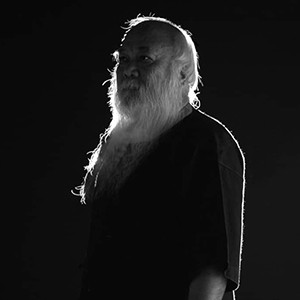
Thawan Duchanee
Thawan Duchanee, National Artist in Visual Arts (Painting), 2001
(1939–2014)
Thawan Duchanee was born in Chiang Rai, between two formative presences: his mother’s quiet devotion to Buddhism and his father’s disciplined life as a hunter. The forest entered his consciousness early. It was not scenery, but experience. Animals, stillness, and the tension between life and death shaped his enduring meditation on instinct and the cyclical nature of existence. He graduated with first-class honors from the Faculty of Painting, Sculpture, and Graphic Arts at Silpakorn University as one of the last students of Professor Silpa Bhirasri. A royal Thai government scholarship later brought him to the Amsterdam National College of Art, where he completed a doctorate in metaphysics and aesthetics. Moving between languages and philosophical traditions, he began to articulate a vision that bridged Eastern metaphysical thought and Western formal inquiry. In 2001, he received the Art and Culture Prize from the Fukuoka Asian Culture Prize Committee.
A public confrontation centering his work in 1971 marked a significant turning point in Thai contemporary art. Students vandalized several of his paintings during his exhibition at the Christian Student Center in Bangkok, perceiving the imagery as disrespectful to Buddhism. Duchanee did not retreat into apology. He spoke instead of coexistence: virtue and baseness, purity and instinct, rising from the same human condition. For him, art was not a surface to be decoded literally, but a space of encounter. Following this episode, he abstained from exhibiting in Thailand for several years, opting instead to pursue his practice overseas, where his work garnered increasing attention.
His artistic language is unmistakable. Decisive lines. Monumental bodies. Forms that hover between animal and myth. Within these surfaces unfold questions of desire and restraint, life and dissolution, and discipline and impulse. Duchanee often spoke of six essential qualities of art: contemplation, emotional resonance, the rhythm of a free spirit, individuality, harmony, and consummate technique. These were not theoretical statements but lived principles. His paintings hold tension without collapse and intensity without excess. They feel measured, yet alive.
In the later decades of his life, Duchanee created Baandam Museum in Chiang Rai, a gathering of more than forty black wooden structures he designed and built himself. Baandam is neither monument nor spectacle. It is a field of thought made inhabitable. Within its shadowed interiors, he assembled horns, hides, bones, and ritual objects he described as instruments for honing imagination. The buildings, darkened with used engine oil, absorb light rather than reflect it. If Baandam may be read as his meditation in space, MOCA BANGKOK preserves an extensive body of his paintings, where the vitality of his line and the depth of his metaphysical inquiry unfold in quiet intensity. Duchanee prepared his coffin in advance, not as drama, but as acceptance. For him, death was not interruption but continuation within the cycle he had contemplated all his life. His work remains, not as a proclamation, but as a presence.
Project artist
No posts found.
