


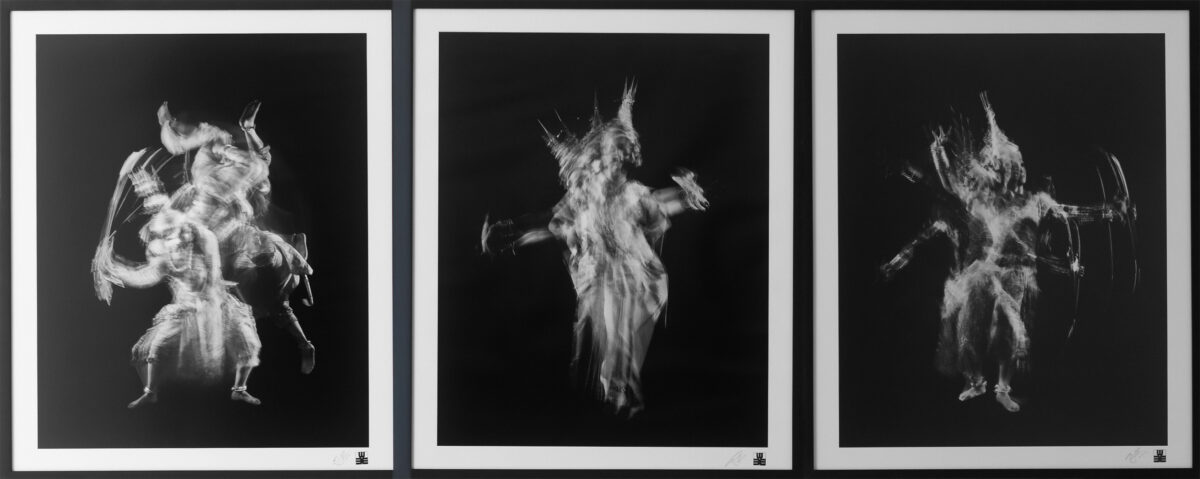
Grace and Power of Motion (A Trilogy)
- Technique : Archival pigment ink on Hahnemühle FineArt Baryta FB 350 gsm
- Size : 100 x 80 cm (each)
- Year : 2018
- Artist : William Barrington-Binns
How does tradition remain alive? This question lies at the heart of Grace and Power of Motion, a trilogy by William Barrington-Binns that approaches Khon as a living form of knowledge carried through the body. The work does not treat tradition as an image to be preserved unchanged, nor as a cultural form held at a distance through nostalgia. It begins with the understanding that heritage endures through practice, repetition, and the continual renewal of movement across time.
Khon is shaped through discipline. Each gesture is learned, measured, and repeated within a structure where movement is never arbitrary. What appears as elegance is sustained through restraint, while what appears as force remains inseparable from form. The body does not simply perform. It carries a language transmitted across generations through precision and care, reflecting the deep cultural significance and historical depth embedded in the performance, which serves as a vital connection to the traditions and values of the community that practices it.
The project began in 2018, at the same moment Khon was recognized by UNESCO as an Intangible Cultural Heritage of Humanity. What first took shape as an attempt to photograph the performance gradually revealed a limit. The image could hold costume and posture but not the movement that gives Khon its structure. What remained absent was the internal rhythm of the body, the continuity that allows each gesture to remain exact while still unfolding in time.
To move beyond mere documentation, the artist spent years developing the project through research, access, and close collaboration. This included securing permissions through Her Majesty Queen Sirikit’s Support Foundation, working with cultural institutions and academics from Thammasat University, and producing the series under the guidance of Khon masters, whose role was essential in ensuring that every hand position and gesture remained exact. In Khon, movement is never merely decorative. It functions as a precise language, and that discipline forms the foundation of the work.
In response, Barrington-Binns developed a photographic method that allows movement to accumulate rather than resolve. Using a manually timed sequence of 17 to 21 flashes, each image is constructed through multiple exposures within a single frame. What appears is not a still image in the conventional sense but a field in which gestures return, overlap, and disperse. Time is not stopped. It is condensed. What remains is not a moment, but a duration held in place.
Within this field, the visual language of Khon remains present. Chromatic logic, ornament, proportion, and hierarchy continue to structure the image as traces of a tradition shaped through long practice. Yet these elements do not settle into fixed signs. Movement alters their function, allowing them to persist without closure. What is inherited is not simply preserved. It is rearticulated.
Installed as a continuous sequence across the wall, the trilogy unfolds through three figures from the Ramakien: Thotsakan, Nang Sida, and Phra Ram. Read from left to right, the works move through distinct states of force, continuity, and control. In Thotsakan, gestures accumulate under pressure, creating a figure that expands beyond itself. In Nang Sida, the rhythm softens, holding presence through continuity rather than force. In Phra Ram, movement gathers toward a more stable axis, where balance is sustained through discipline and restraint.
Grace and Power of Motion does not attempt to fix Khon in place. Instead, it allows the tradition to remain in motion by acknowledging the body as the primary site of transformation. The work affirms that tradition is not sustained through preservation alone but through the body that continues to learn, repeat, and renew.
