


CAMBODIA
For nearly three thousand years, evidence shows that Indian maritime fleets sailed from the subcontinent to Suvarnabhumi for trade and the spread of religion. The French scholar Coedès noted that members of the Pallava royal court migrated to this new land to extend both faith and prosperity.
The region was already inhabited by indigenous peoples. The term Kamboja, now the country’s name, derives from the Kamboj people of northern India, who traced their lineage to Iranian roots. Indian merchant fleets sought favorable sites in the central lowlands of mainland Southeast Asia for commerce and settlement.
Chinese records tell of a Brahmin merchant who married a local princess and proclaimed himself king of Funan, named Koundinya. Funan is recognized as the first major land power in mainland Southeast Asia.
In History of Southeast Asia, M.C. Subhadradis Diskul wrote that Funan was the most important polity in the region and was called the “Land of Gold,” a coastal realm benefiting from the northeast monsoon that aided navigation and trade. Its coastline served as a staging point and transshipment hub for Indian goods, which in turn connected Persian and Roman trade to China. In the same zone, another important polity arose, Champa Desha, located in the Tonkin region and descended from Malayo-Polynesian peoples, as were the Funan and early Khmer.
The Khmer, or Kamboja, received Indian civilizational influences in architecture, sculpture, and culture. Hindu ideas spread through the Vedas and the two great epics, the Mahābhārata and the Rāmāyaṇa, sacred texts that nurtured social harmony.
It is often said that “to study Khmer history is to learn a part of Indian history,” since Khmer art, architecture, literature, and governance reflect India profoundly. During the reign of Jayavarman VII, an integrated network of hospitals, schools, libraries, and roads stretched from Angkor Thom to Champa and Phimai. There were as many as 102 rest houses, testifying to Hindu belief, especially veneration of Śiva.
Khmer history begins anew with a vigorous and Sanskrit-literate civilization that created Angkor Wat and promoted the study of Sanskrit literature. The writing system drew from Indic scripts, and people studied the Vedas, Upaniṣads, and Brāhmaṇa texts.
In this period, the royal honorific “Lord” was used, derived from the Sanskrit “Śrī” in a similar sense, and the concept of Harihara, the fusion of Śiva and Viṣṇu, was embraced.
Hindu grandeur flourished in present-day Vietnam as well, especially in Champa Desha, a significant Hindu sacred complex comparable in scale to Angkor. Dedicated to Śiva, the region is believed to have contained more than seventy Hindu temples. Champa thus stands as a precious testament to Indian civilization in the area.
On the seacoast at O Kaeo, near the tip of the Vietnamese peninsula and once part of Funan, archaeologists have found ceramics, coins, Buddha images, and deities in the Amarāvatī style from India.
In the sixth century CE (B.E. 1043 to 1143), Funan declined and was replaced by Chenla, which deepened Brahmanic Hindu influences alongside the growing appeal of Buddhism.
By the eighth century CE (B.E. 1343 to 1443), Jayavarman II unified Land Chenla and Water Chenla and established Angkor as the political center. The kingdom remained powerful until the fourteenth century CE (B.E. 1843 to 1943).
The historian D.G.E. Hall observed that royal ritual specialists, Brahmin ascetics, advised kings and shaped the new belief system of Devarāja, which regarded the monarch as divinely empowered through Śiva.
Under Suryavarman I and Suryavarman II, the Khmer realm expanded widely. Suryavarman I observed Śaivism while also fostering Mahāyāna Buddhism. During the reign of Suryavarman II, in the twelfth century CE (B.E. 1643 to 1743), devotion shifted to Viṣṇu, and Angkor Wat was built as a major Brahmanic sanctuary dedicated to him.
In the reign of Jayavarman VII, in the twelfth to thirteenth centuries CE (B.E. 1743 to 1843), Angkor Thom and many surrounding temples were constructed. The empire reached its zenith before entering a period of decline.
Later, rulers from Sukhothai invaded during the reign of Jayavarman VIII. During the Ayutthaya period, King Borommarachathirat II, known as Chao Sam Phraya, captured Angkor in 1431 CE (B.E. 1974). The Khmer court moved to Phnom Penh, then to Lovek, and eventually lost independence to Ayutthaya under King Rāmādhipati in 1353 CE (B.E. 1896).
Professor Walter later noted a Khmer inscription from Tanintharyi stating that the Khmer king and his younger brother resided in Ayutthaya from 1462 to 1465 CE (B.E. 2005 to 2008).
The Rāmāyaṇa, composed by the sage Vālmīki, was adapted in Cambodia to suit local society and became known as Reamker or Rama Kerti, interweaving ancient Khmer traditions into the narrative.
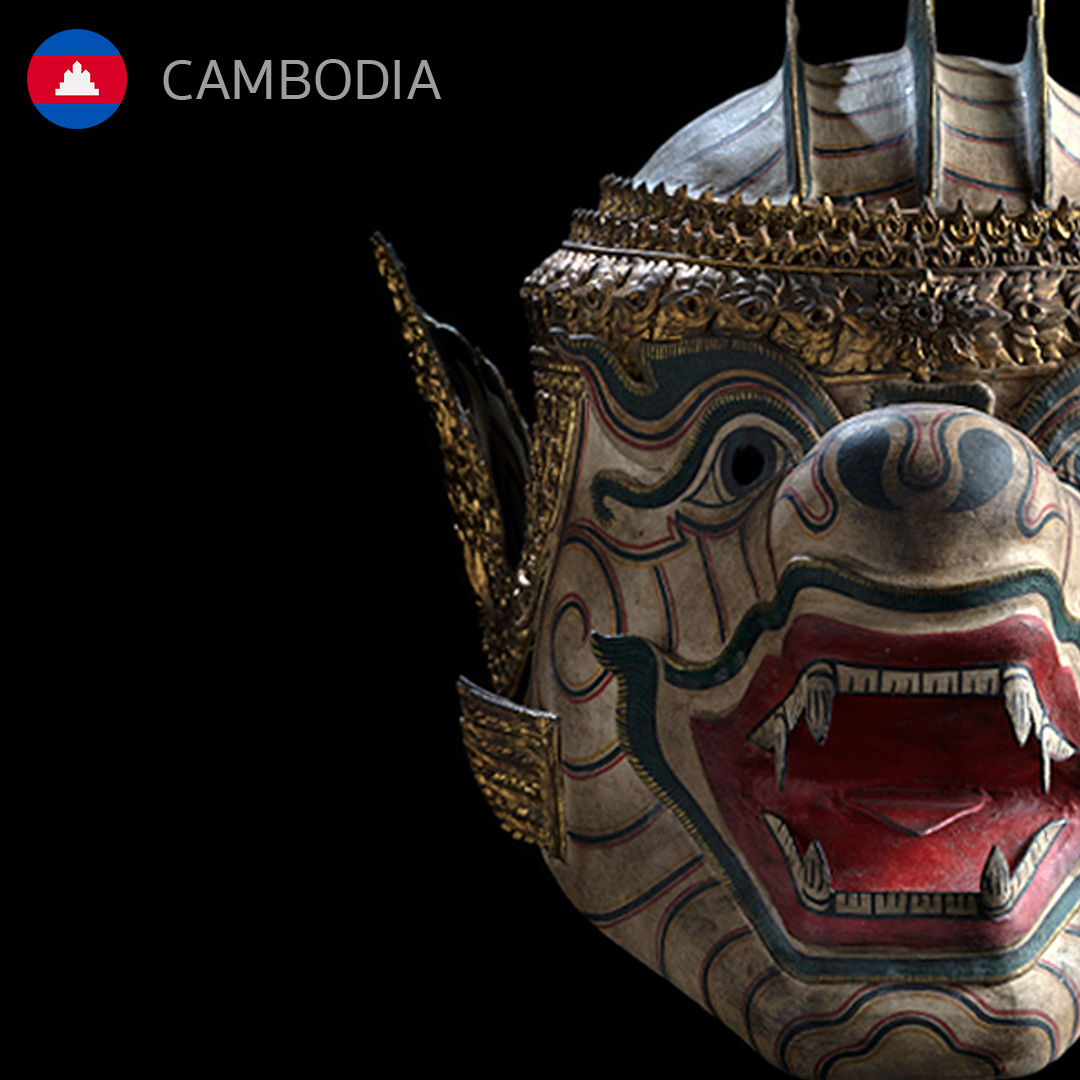
A Balinese-Javanese dancer, author of Ramayana in Art of Asia, recorded that the epic in Cambodia appears not only in the bas-reliefs of Angkor Wat and Angkor Thom, but also in various performing arts such as shadow puppetry, painting, literature, radio drama, and masked theater known as Lakhon Khol.
The earliest evidence of Lakhon Khol dates to the eighteenth century CE (B.E. 2243 to 2343), particularly at Wat Bo, where about one hundred monks have long preserved the murals.
In 1940 CE (B.E. 2483), Preah Mahasatriyani Sisowath Kossamak initiated a royal revival of these court arts in Cambodia, presenting Roborn Tep Apsara, Lakhon Preric’Tep La Khon Luang, and La Khon Kagah Bohram Khmer.
Today, performances of Reamker often serve cultural tourism. They are adapted to modern musical ensembles and emphasize Apsara dance forms rather than detailed narrative. Support for new creations in Khon-style masks has consequently diminished, as seen in the small number of surviving masks that remain today.
