

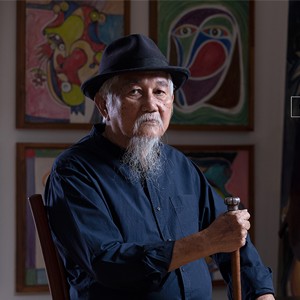
Tawee Ratchaneekorn
Assistant Professor Tawee Nandakwang, National Artist in Visual Arts (Painting), 1990
(1925 to 1991)
Assistant Professor Tawee Nandakwang was born in 1925 in Lamphun Province. After completing his secondary education in his hometown, he moved to Bangkok to continue his studies at Poh Chang School, now Poh Chang Academy of Arts, Rajamangala University of Technology Rattanakosin. In 1943, he enrolled at Silpakorn University as one of its first generation of students, studying under Professor Silpa Bhirasri, who laid the foundation for modern art education in Thailand. Nandakwa graduated from Silpakorn University in 1948. He then taught art at Poh Chang School for five years, from 1949 to 1953, before entering government service at the Department of Rice in 1954. He later returned to art education as a special instructor assisting in the teaching of painting at Silpakorn University. In 1960, he received a scholarship from the Italian government to study painting at the Accademia di Belle Arti di Roma in Rome, Italy, from 1960 to 1961. He completed the highest level of study at the academy within two years, although the program generally took up to four years. After returning to Thailand, Tawee continued to work as an independent artist while teaching at the Faculty of Painting and Sculpture and the Faculty of Decorative Arts, Silpakorn University, until his retirement from government service in 1985.
Throughout his career, Tawee Nandakwang received several important awards and honors. In 1990, he was named National Artist in Visual Arts (Painting) and also received the ASEAN Cultural Award. In 1961, he received a silver medal from an art exhibition in Bracciano, Italy. In 1956, he was honored as an Artist of Distinction in Painting by the National Exhibition of Art. In 1951 and 1953, he received the First Class Honor, Gold Medal, from the 3rd and 4th National Exhibitions of Art, respectively.
Assistant Professor Tawee Nandakwang’s works have been presented in major exhibitions in Thailand and abroad. A commemorative exhibition in his honor was held at the National Gallery, Bangkok, from August 3 to 31, 1990, marking an important exhibition in the later period of his career. Earlier, Tawee participated in an art exhibition in Bracciano, Italy, in 1961 and had submitted works to the National Exhibition of Art continuously since the early 1950s. Today, his works are displayed in the permanent exhibition at MOCA BANGKOK as part of the museum’s presentation of the development of Thai modern art, through the work of an artist who played a significant role in shaping the language of Thai painting.
The early artistic approach of Assistant Professor Tawee Nandakwang was grounded in Realism and Impressionism, beginning with still lifes, landscapes, and portraits. He later developed a distinctive visual language that moved increasingly toward abstraction and surrealism while continuing to use nature as the basis of his work. N. Na Paknam noted in the Dictionary of Art that Nandakwa’s painting method had a distinctive character and attracted many followers, and that several of his students became well-known through his guidance. Tawee’s later works, especially his paintings of lotus flowers, orchids, mountain landscapes, and forests, are not direct realistic depictions of nature. Rather, they combine realism with a surreal sensibility in their manner. Tawee used his immediate surroundings as a starting point, then adjusted, added, reduced, and reorganized them through imagination. These works reveal refined attention to detail, a controlled atmosphere, and a space in which viewers can perceive both formal beauty and the inner feeling of the image. Today, in addition to MOCA BANGKOK, Tawee’s works are preserved in several institutions and organizations, including the National Gallery, Silpa Bhirasri Memorial, the Bank of Thailand, Siam Commercial Bank, and Thewphaingarm School. Tawee passed away on October 10, 1991, at the age of 66, but his works continue to serve as important evidence of the development of Thai modern painting and remain part of the study of Thai art history within museum spaces today.
Project artist
No posts found.
